Most businesses have a problem they can not quite name.
The work gets done. Customers get served. Revenue comes in. But underneath all of that, there is a layer of coordination happening every single day that nobody has ever really looked at. Someone pulls a report together manually. Someone sends the same onboarding email for the hundredth time. Someone checks three different tools to figure out where a deal stands. Someone else sets a reminder to follow up on an invoice that should have been handled automatically two weeks ago.
This is not laziness. It is not even inefficiency, exactly. It is just how most businesses run. The operational layer — the connective tissue between your tools, your people, and your workflows — exists mostly in people’s heads, in spreadsheets, and in the habit of the person who has been doing it longest.
And it works. Until it does not.
What Is an Operating Layer?
An operating layer is the system that connects the work your business does every day and makes it run without someone manually coordinating every step.
Think of it this way. Your business has tools — a CRM, an accounting platform, a project management system, maybe a communication tool like Slack. It has people. And it has processes: the sequence of steps that moves work from start to finished. An operating layer is what sits between all three and makes sure information flows, approvals happen, alerts surface, and the right people know what they need to know without having to go looking for it.
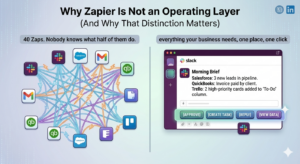
Most companies do not have a real operating layer. They have a patchwork. A mix of automations built at different times for different reasons, a few Zaps that someone set up three years ago, a dashboard nobody checks, and a lot of people doing work that should not require a person at all.
The companies that are pulling ahead right now are the ones that have replaced the patchwork with something intentional. A unified layer that runs the operational side of the business so the people in it can focus on the work that actually requires human judgment.
What Does It Actually Look Like?
The concept sounds abstract until you see it in practice.
Here is a concrete example. Imagine a company running a sales operation. Without an operating layer, the morning looks like this: a sales leader opens their CRM, tries to figure out which deals need attention, checks their email for replies, maybe sends a few follow-ups they meant to send yesterday, updates some deal stages manually, and then gets pulled into a meeting before they can finish.
With an operating layer, the morning looks like this: they open Slack. There is already a brief waiting. Pipeline status. Who replied overnight. Which deals are going cold. Which prospects are ready for the next email. Action buttons right there to move on any of it without switching tools.
The same principle applies across every function in a business.
Finance: Instead of someone logging into your accounting platform every morning to check outstanding invoices, the system surfaces them automatically, flags anything overdue, and projects whether a cash flow gap is forming — before it becomes a crisis.
HR: When someone new joins the team, instead of someone manually sending the welcome email, creating the IT access ticket, sharing the onboarding checklist, and remembering to follow up at the 30-day mark, the workflow runs itself the moment the new hire is added to the system.
Operations: When inventory hits a threshold, instead of someone noticing it eventually, a pre-filled purchase order surfaces in Slack with the supplier’s name, the suggested quantity, and a button to send it. The person makes a decision. The system does the rest.
Manufacturing: Instead of a shift supervisor walking the floor to figure out where the bottleneck is, the system flags it before the shift starts, identifies which line is running below capacity, and surfaces a recommendation for reallocation — before the daily target is at risk.
None of this requires building something completely new. It requires connecting the systems you already have in a way that surfaces the right information to the right person at the right time, and makes it easy to act on.
Why Most Businesses Do Not Have One Yet
The honest answer is that building a real operating layer requires two things most businesses struggle to do at the same time: knowing which process is actually worth automating, and having the technical capability to build it properly.
The first problem is more common than people realize. Most automation projects fail not because the technology does not work but because the wrong problem gets automated first. A team identifies a painful process and automates it, only to discover that the process was painful because of a broken handoff upstream, not because the process itself was wrong. Automating a broken process does not fix it. It accelerates it.
The second problem is the classic build vs. buy dilemma. Most off-the-shelf automation tools give you the infrastructure but not the judgment. They connect your apps but they do not know which workflows matter, which data is messy, or where the real drag in your operation lives. That requires someone who has actually done this before and can walk into your operation and diagnose it before writing a single line of code.
This is why so many companies end up with a patchwork instead of a real operating layer. They buy tools, build a few automations, and then move on. The result is technically automated but practically fragmented.
Where to Start
If you are thinking about building an operating layer for your business, the starting point is not the technology. It is a simple question: what is the one workflow your team does manually every single day that should not require a person at all?
Not the most painful process. The one that would move everything else if it ran automatically.
For most ops teams it is a briefing or a reporting workflow. For most sales teams it is follow-up and pipeline visibility. For most finance teams it is invoice management and cash flow awareness. For most HR teams it is onboarding.
Start there. Build something that works. Then look at what breaks next.
The goal is not to automate everything at once. It is to build a layer that grows with the business, one workflow at a time, until the operational side of the company largely runs itself.
The Slack Angle
One pattern we are seeing consistently in 2026 is that the most effective operating layers are not built on new platforms. They are built inside the tools teams already use every day.
Slack is the obvious example. Most companies already have it. Teams are already in it all day. Building the operating layer inside Slack — rather than in a separate dashboard nobody checks — means the information surfaces where people already are and actions happen in the same place the work gets discussed.
This is what we built at Werx Studio for our own operation. We call it WerxOS. It runs our prospecting pipeline, our financial tracking, our onboarding, and our operational briefs all inside Slack. Every morning the system surfaces what needs attention and makes it easy to act on without opening another tool.
We built it because we needed it. Then people saw it running and started asking us to build it for them.
That is usually how the best operating layers get built. Not from a strategy document. From someone getting tired of doing the same coordination work over and over and finally deciding to fix it.
The Bottom Line
An operating layer is not a product you buy. It is something you build, intentionally, around how your business actually works.
The companies getting it right are not necessarily the most technical ones. They are the ones that have been honest about where their operation leaks — where work slows down, where information gets lost, where someone has to remember something they should not have to remember — and have decided to fix it systematically instead of just hiring someone to manage the chaos.
If your business is growing and your operation is not keeping up, you do not have a people problem or a tools problem. You have an operating layer problem.
And that is fixable.
Werx Studio builds custom operating layers for growing businesses. If you are curious what this could look like for your operation, book a walkthrough or reach out directly.