Zapier is a great tool. This is not a hit piece.
But there is a version of this story that plays out at almost every growing company, and it is worth talking about honestly.
It usually starts the same way. Someone on the ops team — maybe you — discovers Zapier. They build a few automations. A lead comes in from the website and automatically gets added to the CRM. A form submission triggers a Slack notification. New invoice in QuickBooks creates a task in Asana. It works. It feels like magic.
So they build more. Then more. Then a little more.
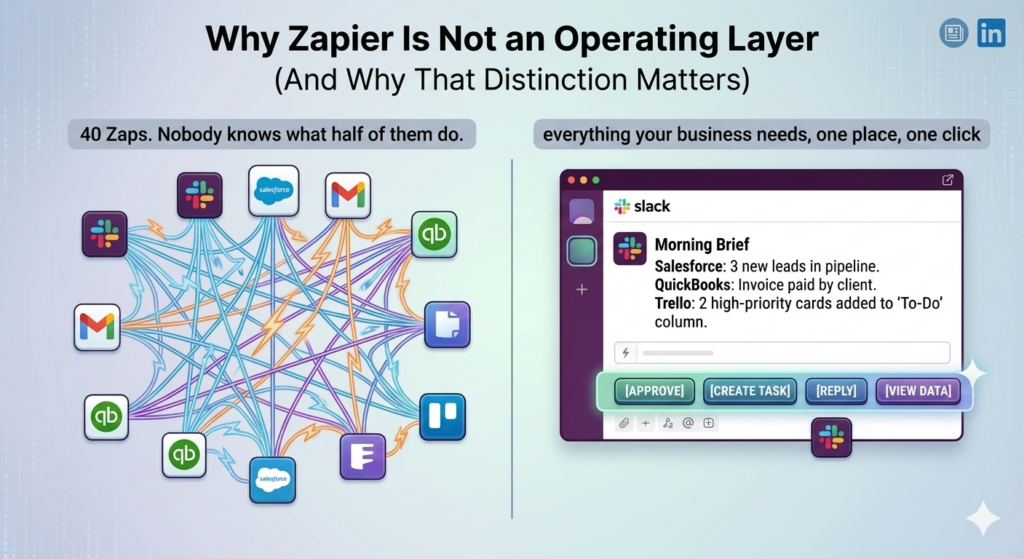
Eighteen months later there are 40 Zaps running. Nobody knows what half of them do. Three of them are broken and have been broken for weeks but nothing visibly exploded so nobody fixed them. One of them was built by someone who left the company. The Zapier bill is $300 a month and climbing. And the ops team is still manually doing most of the same work they were doing before — because the automations handle the easy parts but fall apart the second anything gets even slightly complicated.
This is not a Zapier problem. It’s a category problem. Zapier is a trigger-action tool. It was built to connect apps and move data between them. It is excellent at that. But connecting apps is not the same thing as building an operating layer. And confusing the two is one of the most common and expensive mistakes growing companies make.
What Zapier Actually Does
Zapier’s model is fundamentally this: when X happens in one app, do Y in another app.
New row in Google Sheets? Send an email. Form submitted? Create a contact. Invoice paid? Post to Slack.
That is genuinely useful. For simple, linear, trigger-action workflows it is one of the best tools available. But an operating layer is not a collection of trigger-action workflows. It is a system that understands context, surfaces the right information to the right person at the right time, allows that person to take action, and knows what to do when things do not go as expected.
Zapier does not do any of that. And it was never designed to.
The Four Gaps
1. Zapier does not understand context.
A Zap fires when a trigger happens. It does not know why it happened, whether it matters more or less than the last time it happened, or what the right response is given the current state of the business. It just fires.
An operating layer has context. It knows that this invoice is 30 days overdue and the client has three other open invoices. It knows that this prospect replied warmly and should be escalated. It knows that inventory hitting 12% is critical on a Tuesday before a long weekend but less urgent on a Monday with a shipment incoming. Context is what turns automation from a convenience into intelligence.
2. Zapier does not surface actionable information.
Zapier moves data. It sends notifications. But it does not give you a clean summary of what needs your attention today, organized by priority, with the ability to act on it in the same place you received it.
Think about the difference between getting a Slack ping that says “new invoice overdue” and opening Slack to find a daily brief that shows you all three overdue invoices, their amounts, their days outstanding, and a button to send the reminders directly from that message. The first is a notification. The second is an operating layer.
3. Zapier breaks when reality does not match the workflow.
Every Zap is built on an assumption: that the trigger will always look a certain way and the action will always be appropriate. Real business operations are messier than that. Deals come in with missing fields. Invoices get disputed. New hires join in countries your HR system was not configured for. Suppliers respond with partial shipments.
When any of this happens, a Zap either fires incorrectly or fails silently. Most of the time you do not know until someone notices the downstream problem. An operating layer handles exceptions. It flags them, routes them to the right person, and asks for input rather than quietly breaking.
4. Zapier creates maintenance burden, not operational leverage.
This is the one nobody talks about enough. Every Zap you build is a thing you now have to maintain. When an app changes its API, Zaps break. When a workflow evolves, Zaps have to be rebuilt. When someone new joins the team, they have no idea what any of the Zaps do or why they exist. What started as a solution becomes a system that itself requires a person to babysit it.
The whole point of an operating layer is that it reduces the amount of human coordination your business needs. A pile of Zaps adds to it.
The Real Cost
The most common thing we hear from ops leaders who have been down this road is some version of: “We spent a year building automations and we still have the same problems. We just have more tools now.”
That is not a failure of execution. That is a failure of category. Automation tools and operating layers are fundamentally different things. Using one when you need the other is like buying a really good filing cabinet when what you actually need is a database.
The cost is not just the Zapier bill. It is the opportunity cost of building the wrong thing. Every hour spent building and maintaining Zaps that do not actually solve the coordination problem is an hour not spent building something that does.
What an Operating Layer Actually Looks Like
An operating layer is not a collection of automations. It is a system that runs the operational side of your business the way a brain runs a body — continuously, in context, with the ability to surface problems and act on them before they become emergencies.
In practice this means:
A single place — in most cases, a tool your team already lives in, like Slack — where the relevant state of your business surfaces every morning without anyone going to look for it.
Workflows that run automatically but surface exceptions for human judgment rather than either ignoring them or failing silently.
The ability to take action — approve an invoice, trigger an onboarding flow, create a deal, respond to a prospect — from the same place the information surfaced, without switching tools.
Intelligence that compounds over time. The system gets smarter about what matters and what does not as it runs.
None of this requires ripping out Zapier. Zapier can be part of the stack. But it cannot be the layer. It is connective tissue, not a brain.
The Honest Starting Point
If you have been building Zaps for a year and you still feel like your ops are running on manual effort and people remembering things, you have not failed. You have just been solving the wrong problem.
The question to ask is not “how do I automate more tasks?” It is “what does the operating layer of my business look like, and what would it need to know and do to run itself?”
That is a different question. And it leads to a different kind of build.
Start with the one workflow your team touches manually every single day that has real business impact. Not the most painful process. The most consequential one. Build that properly — with context, with actionable output, with exception handling. Then see what moves.
That is how you go from a pile of Zaps to an operating layer that actually runs your business.
Werx Studio builds custom AI automation operating layers for growing businesses. If you are still stuck in the Zapier trap and want to see what a real operating layer looks like, book a walkthrough or reach out directly.